 Send me a PDF copy
Real-world ready
'My double degree in earth science and law has equipped me with valuable skills and diverse career options. Through hands-on experiences like fieldwork, mock mediations, and an overseas legal placement, I’ve gained practical insights that have made me confident and prepared for the real world. I plan to apply my dual expertise in mining closure or environmental consulting.'
Bachelor of Science/Bachelor of Laws (Honours) student
Hannah's advice
'Study what you enjoy doing. Don't follow the crowd. I ended up in law and science because it was two things that I really enjoyed. You know, even if you're not the one doing the science, having that science knowledge and that science vocabulary is really helpful in a lot of different applications.'
Intellectual property, technology and regulatory lawyer
Hands-on science experiences
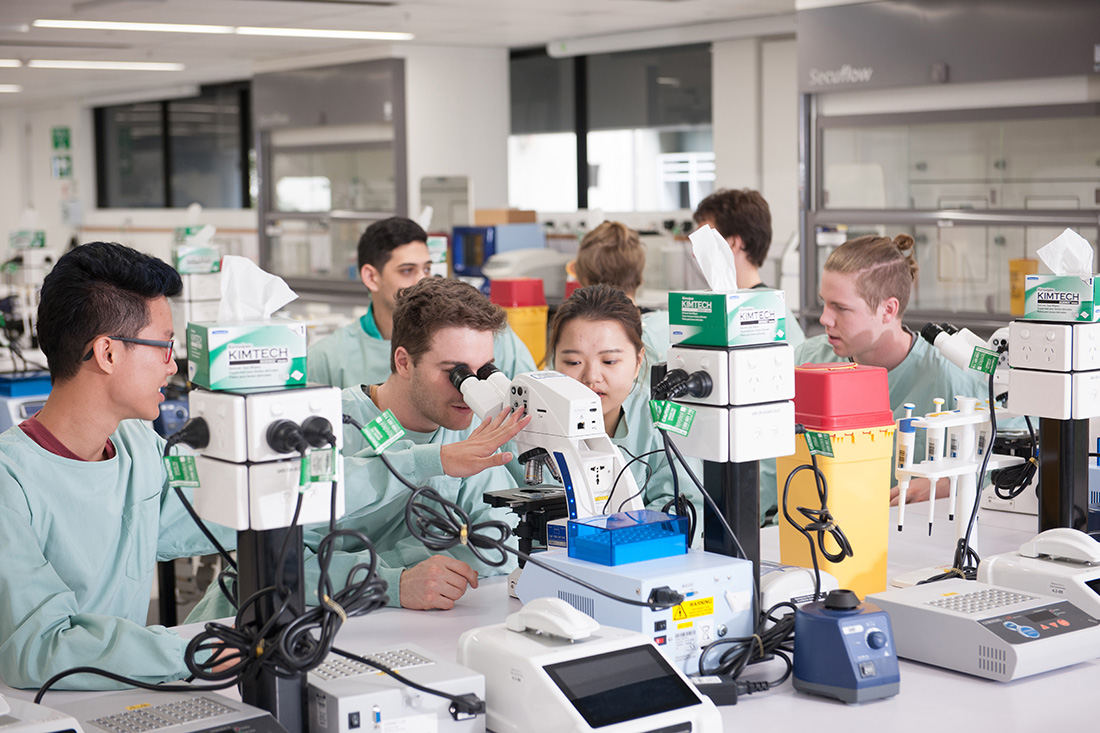
Our science students are introduced to a variety of lab experiences across all majors from the first week of their studies.
Real-world ready
'My double degree in earth science and law has equipped me with valuable skills and diverse career options. Through hands-on experiences like fieldwork, mock mediations, and an overseas legal placement, I’ve gained practical insights that have made me confident and prepared for the real world. I plan to apply my dual expertise in mining closure or environmental consulting.'
Bachelor of Science/Bachelor of Laws (Honours) student
Hannah's advice
'Study what you enjoy doing. Don't follow the crowd. I ended up in law and science because it was two things that I really enjoyed. You know, even if you're not the one doing the science, having that science knowledge and that science vocabulary is really helpful in a lot of different applications.'
Intellectual property, technology and regulatory lawyer


Highlights
- QUT’s law degree prepares you to think ahead and take advantage of employment opportunities in growth areas or newly emerging sectors, such as intellectual property and technology.
- Benefit from meaningful connections with high profile industry employers and classes with leading law experts.
- Learn to develop practical solutions that impact on the real world.
- Be at the cutting edge of international science education with access to QUT’s new multimillion dollar research and teaching facilities, including our $230 million Science and Engineering Precinct.
- Enhance your career prospects with skills like analytical and writing skills that can be applied in both a science and/or legal profession.
- Complete 2 separate degrees in 5.5 years full-time.
Highlights
- QUT’s law degree prepares you to think ahead and take advantage of employment opportunities in growth areas or newly emerging sectors, such as intellectual property and technology.
- Benefit from meaningful connections with high profile industry employers and classes with leading law experts.
- Learn to develop practical solutions that impact on the real world.
- Be at the cutting edge of international science education with access to QUT’s multimillion dollar research and teaching facilities, including our $230 million Science and Engineering Precinct.
- Enhance your career prospects with skills like analytical and writing skills that can be applied in both a science and/or legal profession.
- Complete 2 separate degrees in 5.5 years full-time.
Explore this course
This double degree covers all major areas of the law, as well as allowing students to choose one of the following majors offered in the Bachelor of Science course: biological sciences, chemistry, climate Science, earth science, environmental science and physics. You will be educated in the content and processes of science to prepare you for the complexities of legal issues with a range of scientific and technological dimensions.
Whether you choose biological sciences, chemistry, climate science, earth science, environmental science or physics, your major within the science component of this double degree will provide you with in-depth knowledge and expertise, preparing you for entry into the workforce or further study.
You will explore real-world problems from multiple science perspectives and learn the tools of the trade. Depending on your choices you may find yourself out in the field, working in the laboratory or learning about the impact of scientific theory on people, policy, industry and the planet. Working with data you have collected, you’ll study how to apply fundamental methods of scientific practice, perform scientific analysis, and learn the tools to present your findings.
In your law degree, you will benefit you will benefit from our practical, hands-on approach to teaching, ensuring you gain a comprehensive understanding of the Australian legal system and the core areas of law required for admission to legal practice in Australia.
You’ll gain a strong foundation in key areas of law, including:
- contract law
- legal research
- equity and trusts
- constitutional law
- administrative law
- commercial and personal property law.
In addition to these established areas of law, you’ll have the opportunity to explore emerging areas of legal practice, such as:
- environment, social and governance (ESG) issues
- law, technology and innovation.
You'll also develop a comprehensive knowledge of Aboriginal and Torres Strait Islanders perspectives on law and the legal system, preparing you to work in culturally diverse contexts.
By combining your law degree with a science degree, you could help develop solutions in the areas of climate change, long-term ecological impacts, energy and geosystems, food security and water resource management.
Careers and outcomes
As a graduate, you may enter legal practice with an education in both the content and process of science and data analysis. This will enable you to deal with the complexities of litigation that have a scientific or technological focus such as inventions, trade secrets, quantitative evidence, genetic modification and constitutional disputes giving rise to environmental issues.
On the other hand, you may choose to follow a career path in the sciences, enhancing your opportunities in a particular discipline such as environmental science or biotechnology through your knowledge of the law.
Professional recognition
The Bachelor of Laws (Honours) is a Legal Practitioners' Admissions Board (LPAB) approved law degree, meaning you are eligible for admission to the Australian Legal Profession. To become a solicitor, you must also complete LPAB approved Practical Legal Training. We are one of the few Australian Law Schools to offer approved Practical Legal Training through our Graduate Diploma in Legal Practice. To work as a Barrister there are additional training requirements after you are admitted to the legal profession.
Possible careers
- Climate change policy adviser
- Energy policy officer
- Environmental health officer
- Environmental lawyer
- Forensic scientist
- In-house lawyer
- Intellectual property lawyer
- Inventor
- Lawyer
- Occupational health and safety adviser
- Patent lawyer
- Policy analyst
- Research ethics and policy adviser
Science Component:
For the Bachelor of Science (Study Area A), you must complete:
- 54 credit points of core units;
- 6 credit points selected from the Maths Core Unit Options List;
- 120 credit points of one (1) Major (Study Area A) selected from:
- Biological Sciences
- Chemistry
- Climate Science
- Earth Science
- Environmental Science
- Physics
Law Component:
To meet the requirements of the Bachelor of Laws (Honours) component of the double degree, you must complete a total of 324 credit points comprising:
- Twenty core units – 240 credit points
- Two Advanced law electives - 24 credit points
- A law minor (48cp) and one unit (12cp) of law / general electives OR two law electives (24cp) and three law / general electives (36cp) – 60 credit points
The QUT You component is comprised of 24 credit points of QUT You units.
Science Component:
For the Bachelor of Science (Study Area A), you must complete:
- 54 credit points of core units;
- 6 credit points selected from the Maths Core Unit Options List;
- 120 credit points of one (1) Major (Study Area A) selected from:
- Biological Sciences
- Chemistry
- Climate Science
- Earth Science
- Environmental Science
- Physics
Law Component:
To meet the requirements of the Bachelor of Laws (Honours) component of the double degree, you must complete a total of 324 credit points comprising:
- Twenty core units – 240 credit points
- Two Advanced law electives - 24 credit points
- A law minor (48cp) and one unit (12cp) of law / general electives OR two law electives (24cp) and three law / general electives (36cp) – 60 credit points
The QUT You component is comprised of 24 credit points of QUT You units.
- ATAR/selection rank threshold
- 84.00
These thresholds are the lowest adjusted scores to which QUT made an offer in Semester 1, 2026.
Don't have a ATAR/selection rank?
- Course code
- ID42
- QTAC code
- 419712
- CRICOS code
- 083029M
-
- Gardens Point
-
- Gardens Point
- 5.5 years full-time
- 5.5 years full-time
- February and July
- February and July
Assumed knowledge
Before you start this course, we assume you have sound knowledge of the subject/s listed below. If you don't have the subject knowledge, you can still apply for the course but we strongly encourage you to undertake bridging studies to gain the knowledge:
- English, or Literature, or English and Literature Extension, or English as an Additional Language (Units 3 & 4, C)
- Mathematical Methods, or Specialist Mathematics (Units 3 & 4, C)
Offer guarantee
If you achieve an ATAR or selection rank of 87.00 or higher (including any adjustments) and satisfy all other admission requirements, you are guaranteed an offer for this course in the Semester 1 offer rounds, up to the main offer round in mid-January.
VET guarantee
If you have completed an AQF diploma or higher, and satisfy all other admission requirements, you are guaranteed an offer for this course in the Semester 1 offer rounds, up to the main offer round in mid-January.
Advanced standing
If you have prior studies or work experience, you may be eligible for advanced standing (credit). You can apply for advanced standing once you've been accepted to QUT. If you're in your first semester of study, you must apply for advanced standing within 10 days of receiving your offer.
Deferment
You can defer your offer and postpone the start of your course for one year.
More about deferring your offer
Adjustments to your ATAR/selection rank
Any adjustments you receive to your ATAR or selection rank will be applied to this course.
Find out if you’re eligible for an adjustment to your ATAR or selection rank
Offers we made to school leavers in Semester 1, 2026
The figures listed in the tables below reflect the offers that were made to recent ATAR students. The entry thresholds box at the top of this page shows the lowest adjusted ATAR/selection rank required to receive an offer for all applicants for the most recent January QTAC offer round.
| Excluding adjustments | Including adjustments | |
|---|---|---|
| Highest ATAR/selection rank to receive an offer |
Selection rank
97.45
|
Selection rank
99.30
|
| Median ATAR/selection rank to receive an offer |
Selection rank
91.45
|
Selection rank
94.95
|
| Lowest ATAR/selection rank to receive an offer |
Selection rank
82.35
|
Selection rank
86.35
|
You can find out more about your fellow students’ backgrounds with this course’s student profile.
Other admission options
If you are of Aboriginal or Torres Strait Islander descent, you may be eligible for admission through our Centralised Assessment Selection Process (CASP).
I completed my studies outside of Australia
Select the country where you completed your studies to see a guide to the grades you need to apply for this course.
If your country or qualification is not listed, you can still apply for this course and we will assess your eligibility.
Assumed knowledge
- Mathematical Methods, or Specialist Mathematics (Units 3 & 4, C)
You must have achieved this study at a level comparable to Australian Year 12 or in recognised post-secondary studies.
I completed secondary school in Australia
Assumed knowledge
Before you start this course we assume you have sound knowledge in these areas:
- Mathematical Methods, or Specialist Mathematics (Units 3 & 4, C)
- ATAR/selection rank
- 84.00
Offer guarantee
If you completed secondary school in Australia and achieve an ATAR/selection rank of 87.00 or higher (including any adjustments) and satisfy all other admission requirements, you are guaranteed an offer for this course.
VET guarantee
If you have completed an AQF diploma or higher, and satisfy all other admission requirements, you are guaranteed an offer for this course.
Minimum English language requirements
Select the country where you completed your studies to see a guide on meeting QUT’s English language requirements.
Your scores and prior qualifications in English-speaking countries are considered. Approved English-speaking countries are Australia, Canada, England, Ireland, New Zealand, Scotland, United States of America and Wales.
If your country or qualification is not listed, you can still apply for this course and we will assess your eligibility.
We accept English language proficiency scores from the following tests undertaken in a secure test centre. Tests must be taken no more than 2 years prior to the QUT course commencement.
| English Test | Overall | Listening | Reading | Writing | Speaking |
|---|---|---|---|---|---|
| IELTS Academic / One Skill Retake | 6.5 | 6 | 6 | 6 | 6 |
|
Cambridge C1 Advanced
You must share your results with QUT through the Candidate Results Online website. |
176 | 169 | 169 | 169 | 169 |
| PTE Academic | 58 | 50 | 50 | 50 | 50 |
| TOEFL iBT Australia Test (120 scale) | 79 | 16 | 16 | 21 | 18 |
Don't have the English language score you need? We can help!
We offer English language programs to improve your English and help you gain entry to this course.
When you apply for this course, we will recommend which English course you should enrol in.




Your actual fees may vary depending on which units you choose. We review fees annually, and they may be subject to increases.
2027 fees
2027: Fee available from October
2027 fees
2027: $47,900 per year full-time (96 credit points)
2026 fees
2026: CSP $13,400 per year full-time (96 credit points)
2026 fees
2026: $46,200 per year full-time (96 credit points)
Student services and amenities fees
You may need to pay student services and amenities (SA) fees as part of your course costs.
HECS-HELP: loans to help you pay for your course fees
You may not have to pay anything upfront if you're eligible for a HECS-HELP loan.
Student services and amenities fees
You may need to pay student services and amenities (SA) fees as part of your course costs.
You can apply for scholarships to help you with study and living costs.
International Merit Scholarship
A high achievement scholarship for future international undergraduate and postgraduate students.
- Scholarship eligibility
- Academic performance
Faculty of Science Indigenous Australian Scholarship
We are committed to improving Aboriginal and Torres Strait Islander participation in science, maths and IT and ensuring students reach their full potential.
- Scholarship eligibility
- Indigenous Australian; Academic performance
International Talent Scholarship
A new scholarship for 2026 that covers tuition fees, with eligibility based on your prior academic achievements.
- Scholarship eligibility
- Academic performance
Keep up to date
Ready for your next step?
Finishing school?
Everything you need to know about choosing a uni straight from school.
How to apply
We'll break down the application process, from QTAC to accepting your offer.
Ready for your next step?
How to apply
We'll break down the process, from applying to accepting your offer.
Flexible study
Explore the options that could make postgraduate study work for you.
QUT courses for you
Like to save your courses?
Please enter your first name and email so we can save your courses for you